Vol. 60., No. 1, 2025
Abstract
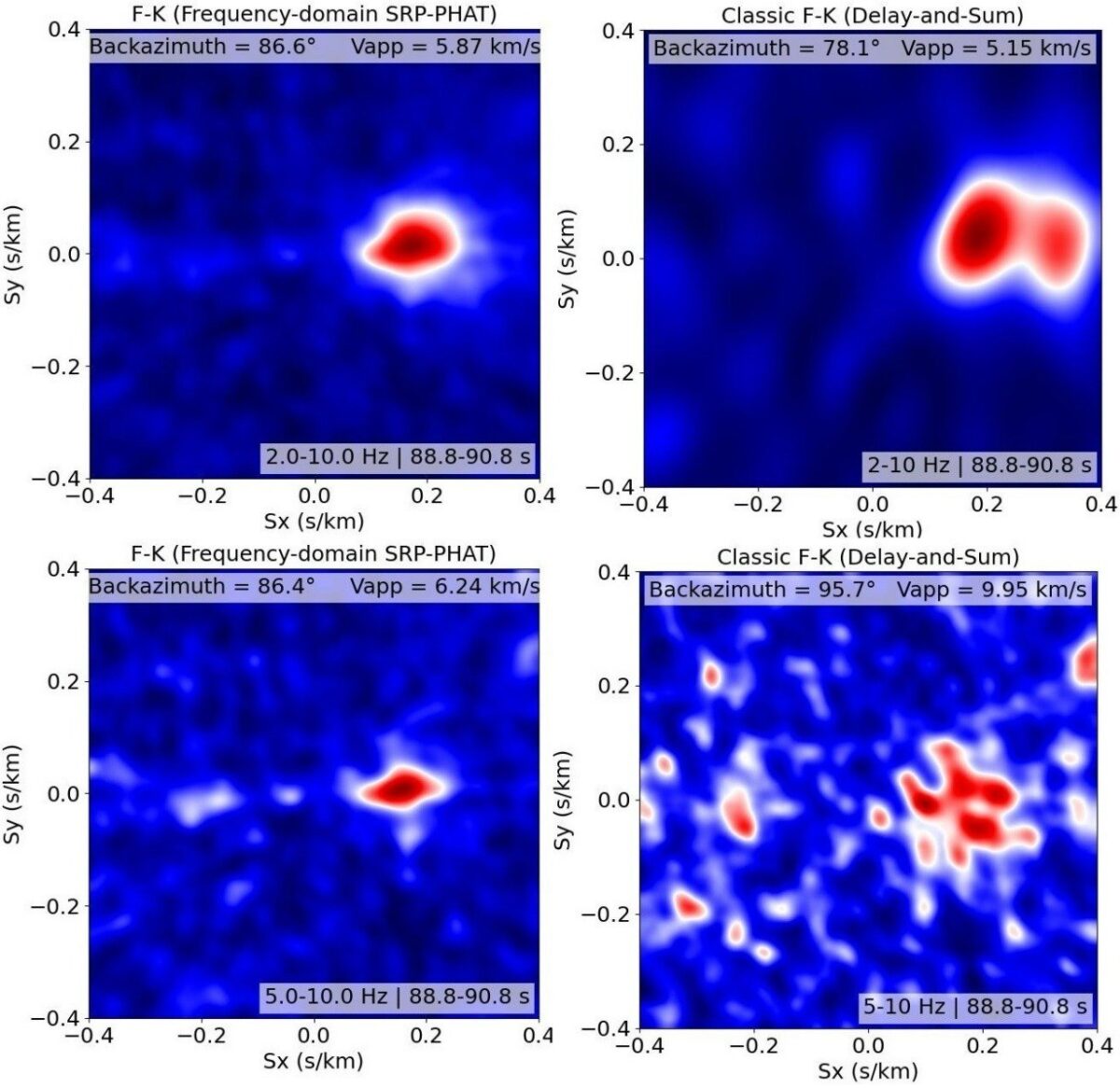
The Steered Response Power – Phase Transform (SRP–PHAT) method, originally developed in acoustics for robust source localization in noisy and reverberant environments, is evaluated for applications to small-aperture seismic arrays. This study demonstrates that SRP–PHAT can effectively address two related tasks: microseismic source localization and frequency–wavenumber ( f –k) spectrum estimation. A theoretical framework is provided, highlighting the conceptual similarity between these tasks, followed by experimental validation using real seismic data. Three different datasets are analyzed: (1) recordings of the S phase from the Kursk submarine explosion (August 12, 2000) captured by the ARCES array; (2) data from a temporary array deployed for tremor source monitoring; (3) data from a seismic array used in microseismic monitoring during hydraulic fracturing. The results illustrate several cases in which SRP–PHAT provides more stable or accurate slowness estimates than conventional methods, suggesting that it represents a viable alternative to classical f –k approaches, without claiming universal superiority.